Welcome to Foshan Tiange Acoustic And Decor Material Co., Ltd.
-
Tel : +8617322789466
-
Email : gsacousticss@gmail.com

What are you looking for?
Welcome to Foshan Tiange Acoustic And Decor Material Co., Ltd.


Tel : +8617322789466
Email : gsacousticss@gmail.com
Professor Lu Qingpu Delivers a Lecture at TianGe Acoustic Group
To accurately grasp the policy guidance and practical key points in the field of noise pollution prevention and control, and to build a solid sound environment protection line for quality living, Professor Lu Qingpu, a professor-level senior engineer from the former Guangzhou Environmental Monitoring Center Station (now the Guangdong Provincial Guangzhou Ecological Environment Monitoring Center Station), was recently invited to TianGe Acoustic Group to conduct a special lecture. Drawing on decades of profound experience in environmental noise and vibration monitoring, Professor Lu focused on the "Technical Policy for the Prevention and Control of Ground Traffic Noise Pollution," combining typical cases of noise pollution in residential communities to systematically interpret the relevant policies and standards for noise pollution prevention and control and the construction of "good houses," bringing the audience a knowledge feast that was both professional and practical.
Professor Lu Teaches at TianGe Acoustic
As a leading expert in the field of noise and vibration monitoring, Professor Lu Qingpu has personally witnessed the development and improvement of my country's environmental noise pollution prevention and control system, possessing both solid theoretical foundation and rich practical experience. At the beginning of his lecture, he provided an in-depth interpretation of the core principles of the "Technical Policy for the Prevention and Control of Ground Traffic Noise Pollution," breaking down the policy requirements and technical pathways from the general principles of "prevention first, layered control, and people-oriented" to the five key aspects of rational planning and layout, noise source control, sound transmission path reduction, sensitive building protection, and traffic noise management. He emphasized that the prevention and control of ground traffic noise is not a single-stage effort, but a systematic project that runs through the entire process of planning, construction, and operation. For example, newly built traffic lines should prioritize avoiding noise-sensitive areas, and rail transit passing through urban centers should preferably use underground routes. In noise-sensitive sections, sound barriers and low-noise pavements can be used in combination with practical considerations. These policy requirements provide clear guidance for acoustic management work.
Beyond theoretical interpretation, Professor Lu transformed abstract policy standards into practical experience by drawing on numerous case studies of noise pollution in residential communities. He addressed common pain points in residential communities, such as traffic noise infiltration, equipment operation noise interference, and poor sound insulation between neighbors, reviewing the key successes and failures of several typical governance cases. For example, regarding the problem of excessive noise in residential communities near urban expressways, he analyzed in detail how to achieve compliance by combining the limits for Class 1 functional areas in the "Environmental Noise Quality Standard" with a "vibration reduction + building sound insulation optimization" solution. Regarding the structural noise pollution from shared facilities and equipment such as elevators and water pumps in older communities, he explained the specific technical points of equipment vibration reduction retrofitting and pipeline sound insulation treatment, referring to the "Code for Sound Insulation Design of Civil Buildings." These case studies, closely aligned with reality, gave the audience a more intuitive understanding of the complexity and targeted nature of noise pollution control.
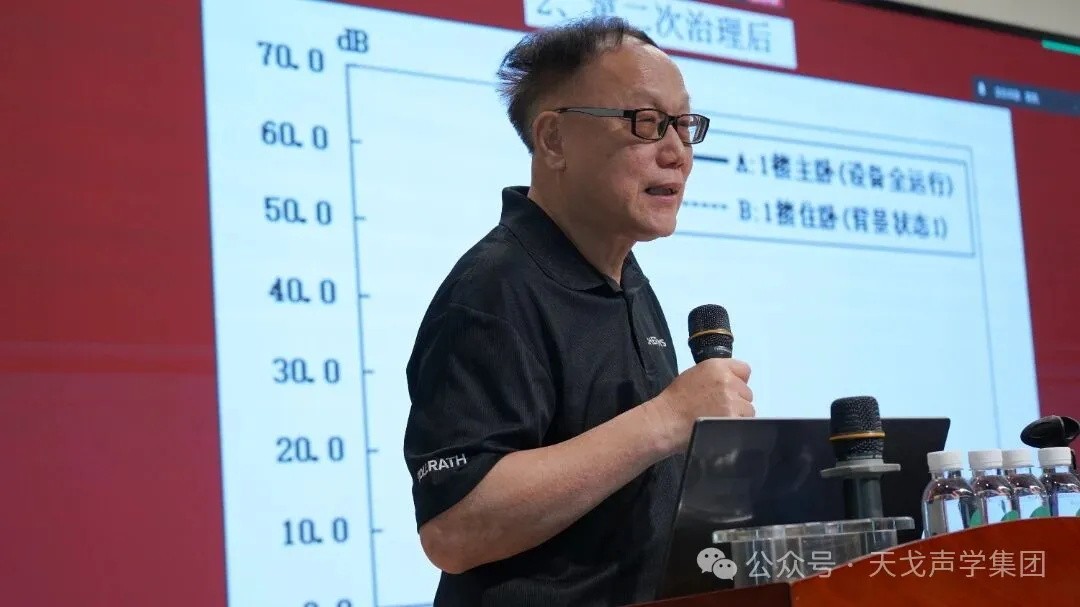
Professor Lu meticulously reviewed the latest policies, regulations, and industry requirements regarding the acoustic environment standards and practical applications of "good housing." He pointed out that one of the core elements of "good housing" is a high-quality acoustic environment, a requirement that has been incorporated into numerous mandatory standards. From the new requirements in the "Residential Project Specifications" that raise the sound insulation performance of bedroom partition walls to 50 decibels and reduce the floor impact noise limit to 65 decibels, to the "Noise Pollution Prevention and Control Law" which mandates that real estate developers disclose the noise impact and prevention measures of housing and include sound insulation in sales contracts, a series of policies and standards have established the hard standards for the acoustic environment of "good housing." Drawing on his own monitoring experience, he shared how to verify the compliance of building sound insulation design through scientific noise monitoring data, and how to optimize noise prevention solutions for different apartment types and surrounding environments. This provided important reference for TianGe Acoustic Group's technological research and development and project implementation in the field of residential acoustic management.
During the lecture, Professor Lu also engaged in in-depth interaction with the on-site technical personnel, answering questions one by one regarding policy application difficulties and technology selection challenges encountered in actual projects, and sharing his years of accumulated practical skills. He emphasized that acoustic treatment companies must not only accurately grasp the bottom-line requirements of policy standards, but also innovate technical solutions based on the actual situation of the project, taking into account the treatment effect, economy, and landscape harmony, to truly achieve the goal of "returning tranquility to residents."
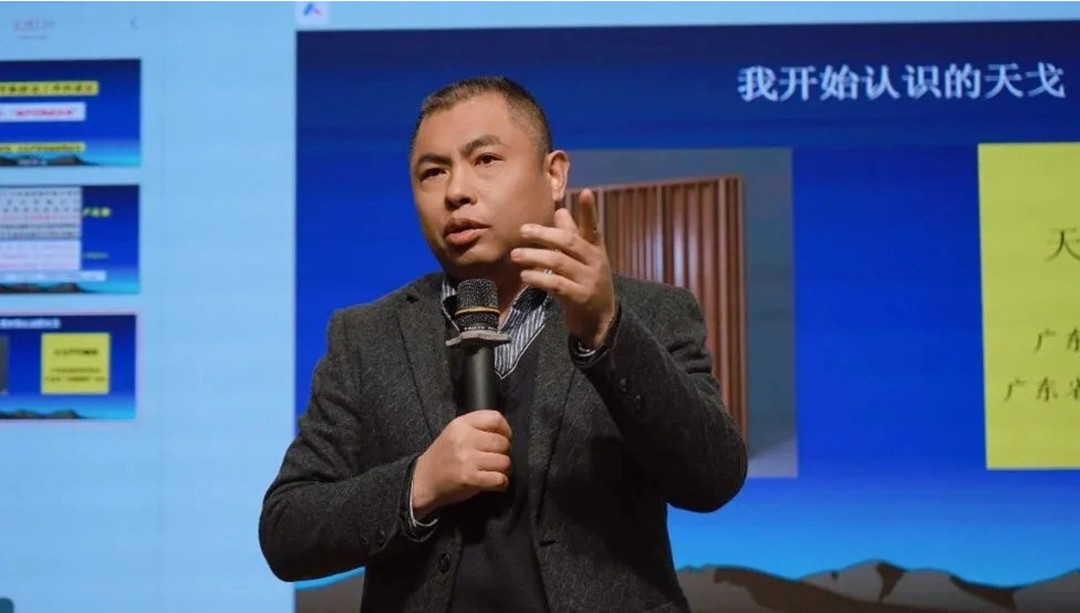
At the end of the lecture, Mr. Huang, founder of TianGe Acoustic, shared his insights and future outlook. He stated that Professor Lu's lecture combined policy perspectives with practical depth, clarifying the policy boundaries of industry development while providing feasible technical pathways, which greatly inspired and enriched the team. Mr. Huang emphasized that since its inception, TianGe Acoustics has been deeply committed to "protecting tranquil living spaces" and has been deeply involved in the field of acoustic management. Professor Lu's professional sharing has injected new ideas into the company's subsequent technology research and development and project implementation. In the future, the group will translate what it has learned into practical actions, strictly adhere to various policy standards, combine the practical experience shared by Professor Lu, continuously optimize residential acoustic solutions, refine each project with more sophisticated technology and a more rigorous attitude, use professional expertise to solidify the acoustic environment foundation of "good houses," create tranquil and comfortable living spaces for more families, and contribute to the high-quality development of the industry.
If you have more question, please feel free to contact with us, Thank You !
WeChat/WhatsApp: +8617322789466
Email: gsacousticss@gmail.com
Company Address: No.16, Jujin Road, Baini Town, Sanshui District, Foshan City, Guangdong Province, China.

Tel : +8617322789466
Email : gsacousticss@gmail.com
No.16, Jujin Road, Baini Town, Sanshui District, Foshan City, Guangdong Province, China.